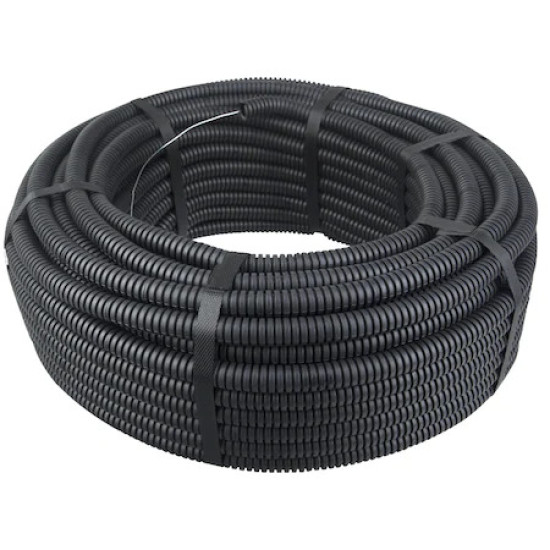
Copex is the corrugated conduit, with rings, through which the cables are pulled so as to be shielded from impacts, abrasion and rodents. The corrugation of the wall makes it very flexible, so it can follow tight bends without connecting pieces, and at the same time gives it a better crush resistance than an equivalent smooth conduit. It is made of self-extinguishing PVC: if a flame appears and then disappears, the conduit extinguishes itself and does not carry the fire further along the route.
The 25 mm diameter is the middle size, suitable for an individual string cable, for a pair of solar cables or for medium-power alternating current circuits. The 50 m roll is the standard delivery format and covers long routes without splices. Installation is done on the surface, with clips or cable ties at regular intervals, or buried in plaster and screed, and the cables are pulled with a draw wire, leaving enough room for the pulling to be easy and for the heat to be able to escape. To remember for photovoltaic installations: standard PVC is not stabilised for long exposure to the sun, so on the roof and on the facade UV-resistant versions or metal conduit are used, while ordinary copex remains the solution for indoor sections and for buried routes.
Flexible corrugated conduit of self-extinguishing PVC for the protection and management of cables, nominal outer diameter 25 mm, 50 m roll, reference standard EN 61386-22 for flexible conduit systems in electrical installations. Surface installation on clips or cable ties, or buried in plaster and screed. The self-extinguishing requirement is usual in building electrical installations and all the more relevant on the DC side of a photovoltaic system, where the cable remains live whenever the panels are illuminated. It is not intended for prolonged direct exposure to ultraviolet radiation.
Who it suits
Suitable for indoor routes with one or two solar cables, or for medium-power AC circuits, in residential photovoltaic installations.
Terms explained
- Self-extinguishing (fire-retardant): The material does not sustain burning: after the flame is removed it extinguishes itself and does not propagate the fire.
- String cable: The cable that brings the current from a row of panels to the inverter or to the DC board.
- Surface installation: A route installed visibly on the wall or on the ceiling, fastened with clips, not hidden in the wall.
Technical specifications
| Type | Tub riflat flexibil (copex) pentru protectia si managementul cablurilor |
|---|
| Material | PVC autostingator (ignifug), nu intretine arderea |
|---|
| Nominal outer diameter | 25 mm |
|---|
| Roll length | 50 m |
|---|
| Installation method | Aparent, pe cleme sau coliere, ori ingropat in tencuiala si sapa |
|---|
| Reference standard | EN 61386-22 - sisteme flexibile de tuburi pentru instalatii electrice |
|---|
| UV resistance | Nu este destinat expunerii directe prelungite la soare; pentru exterior se folosesc variante rezistente la UV |
|---|
Recommended applications
- Protection of DC string cables on the indoor route to the inverter
- Protection of the AC circuits and of the installation's communication cables
- Routing cables through walls, attic or technical shafts
- Routes buried in plaster in residential electrical installations
Technical details
Generic product — standard specifications
The 25 mm copex conduit is the medium-size version of the system of flexible corrugated conduits of self-extinguishing PVC, used for the mechanical protection of cables. The corrugation of the wall gives it great flexibility in bending, allowing the route to be followed with tight bends without fittings, and at the same time a crush resistance superior to an equivalent smooth conduit. The 25 mm diameter is suitable for individual string cables, pairs of solar cables or medium-power AC circuits.
The self-extinguishing material characteristic, marketed as fire-retardant, means that the conduit extinguishes itself after the flame source is removed and does not propagate burning along the route. It is a usual requirement in building electrical installations and all the more relevant on the DC side of a photovoltaic system, where the cable remains live whenever the panels are illuminated.
Installation is done on the surface, with clips or cable ties at regular intervals, or buried in plaster and screed. The cables are pulled with a draw wire, keeping a fill ratio that allows both the pulling and the dissipation of heat. The 50 m roll is the standard delivery format and covers long routes without splices.
For photovoltaic applications it must be remembered that standard PVC is not stabilised for direct and prolonged exposure to ultraviolet radiation. On the roof and facade UV-resistant versions or metal conduit are used, while ordinary copex remains the suitable solution for indoor sections and for buried routes.