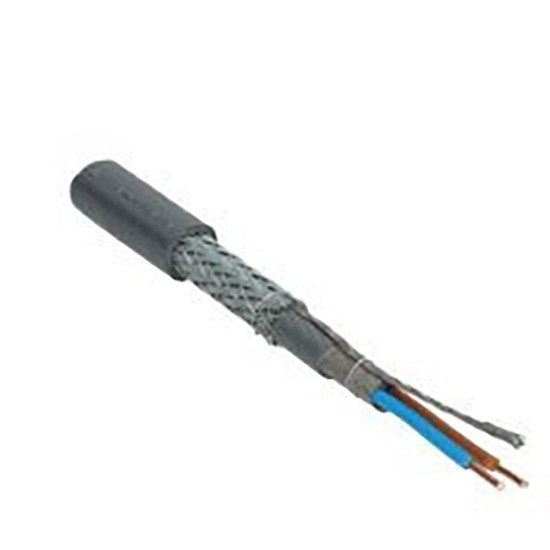
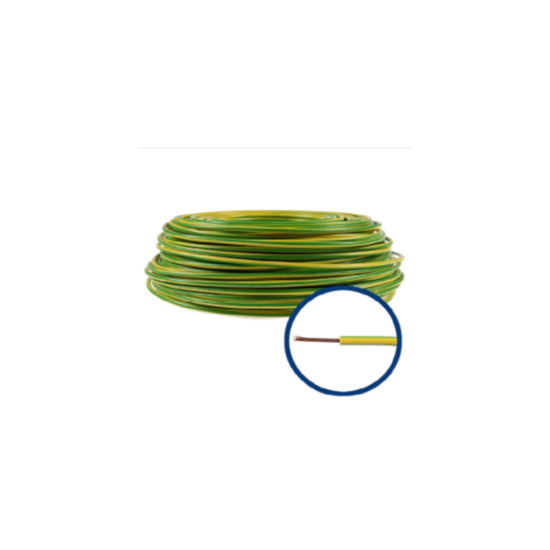
It is a robust cable, made to stay in the ground, not just to be pulled through walls. Besides the two insulated copper wires, it has under the sheath a metal mesh called an earthing screen. Its role is safety: if someone strikes the cable with a spade or with machinery, the fault current is conducted through the screen towards the earthing installation, instead of passing through the person.
The two copper conductors have 4 mm² each, and the rated voltage of 0.6/1 kV makes it suitable both for low power supplies and for signal and control runs over long distances, where a thin wire would have too high a resistance. In a photovoltaic installation it is typically used for the buried link between the house and the annexe housing the inverter and the batteries. It can be laid directly in the ground, in a conduit or in a duct, and the PVC sheath protects it against moisture and mechanical stress. The reaction to fire class is Dca-s2, d2, a3 according to EN 13501-6, the level usually required for supply cables in homes, commercial and industrial spaces. It requires no maintenance, but the buried route is worth marking, so that it is avoided during later digging.
Installation cable VO-YMvKas (Dutch nomenclature), 2 x 4 mm², individually insulated copper conductors, metal earthing screen under the outer PVC sheath, rated voltage 0.6/1 kV, CPR reaction to fire class Dca-s2, d2, a3 according to EN 13501-6. Direct laying in the ground, in a conduit or in a duct, including on outdoor routes that require additional mechanical protection. The installation observes the minimum bending radius and the minimum laying temperature specific to the PVC sheath; the terminations are made in sealed junction boxes, and the earthing screen must be connected to the equipotential bonding bar.
Who it suits
Suitable when the inverter and the batteries sit in an annexe separate from the house, and the link has to run buried, mechanically protected and protected against moisture.
Terms explained
- Earthing screen: The metal mesh under the cable sheath, which takes up the current if the cable is accidentally pierced.
- Rated voltage 0.6/1 kV: The maximum voltage for which the insulation of the cable is built, far above the 230 V of an ordinary socket.
- Reaction to fire class (CPR): European classification showing how quickly the cable contributes to the spread of a fire.
Technical specifications
| Cable type | VO-YMvKas (Dutch nomenclature), buried installation cable |
|---|
| Number and cross-section of conductors | 2 x 4 mm2 |
|---|
| Rated voltage | 0,6/1 kV |
|---|
| Conductor | Copper |
|---|
| Outer sheath | PVC |
|---|
| Screen | Earthing screen under the outer sheath |
|---|
| Reaction to fire class (CPR) | Dca-s2, d2, a3 (EN 13501-6) |
|---|
| Laying method | Buried directly in the ground, in a conduit or in a duct |
|---|
Recommended applications
- Buried links between the building and the annexe with the inverter or batteries
- Low voltage supply and control runs that require mechanical protection
- Outdoor circuits in residential and commercial photovoltaic installations
- Low power supplies over long distances, where protection against damage is required
Technical details
Generic product — standard specifications
VO-YMvKas 2x4 mm2 is a low voltage installation cable made according to the Dutch nomenclature, with a rated voltage of 0.6/1 kV. It contains two copper conductors of 4 mm2, individually insulated, over which there is a metal earthing screen and the outer PVC sheath. The earthing screen has a protective role: in case of mechanical damage to the cable, the fault current is conducted through the screen towards the earthing installation, instead of passing through personnel or machinery.
The construction makes it suitable for direct laying in the ground, in a conduit or in a duct, as well as for outdoor routes where additional mechanical protection is necessary. The reaction to fire class according to CPR is Dca-s2, d2, a3 following EN 13501-6, which corresponds to the usual requirements for supply cables in residential buildings, commercial and industrial spaces.
In photovoltaic installations with storage the cable is used for buried or protected links between building bodies, for example between the house and an annexe housing the inverter and the batteries, where the route must resist mechanically and be protected against moisture. The 4 mm2 cross-section on two conductors covers both low power supplies and signal and control runs over long distances, where the ohmic resistance of a thin signal cable would be too high.
The installation is carried out observing the minimum bending radius and the minimum laying temperature specific to the PVC sheath; the ends are terminated in sealed junction boxes, and the earthing screen must be connected to the equipotential bonding bar.