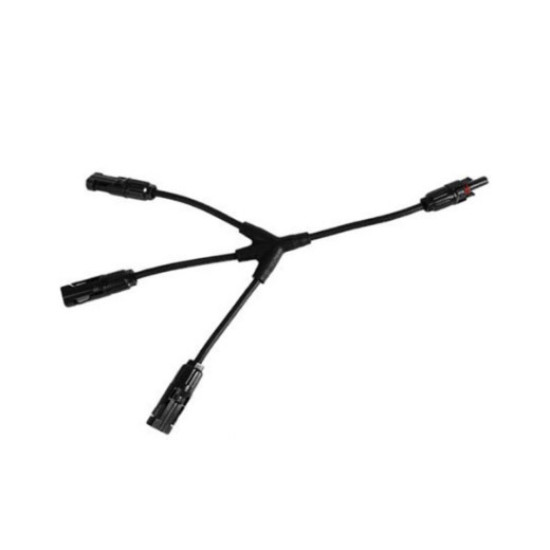
A splitter is, in plain terms, a multiple plug for photovoltaic panels: instead of pulling three separate cables up to the inverter, you gather all three into a single one, right next to the panels. This variant has three female-type terminals, into which the cables of the three strings enter, and a single male terminal that goes further on. It covers only one of the two polarities of the installation, and its counterpart (with three male terminals and one female) is installed on the opposite polarity; only together do they form the complete node.
In practice, a pair of such splitters lets you connect three panel strings to the same inverter input, a useful solution when you want more power but can no longer add panels in series without exceeding the maximum admissible voltage. The part sits outside, on the roof or on the structure, and has protection rating IP68, so it withstands rain and dust without additional protection. It is installed on solar cable with cross-sections between 2.5 and 10 mm², that is exactly the range used in residential installations, and the gland nut has a ratchet that prevents it from loosening on its own over time. One aspect to remember: through the common cable passes the sum of the currents of the three strings, so that cable and the fuse after it are chosen for the summed current, not for that of a single string.
Rated voltage 1500 V DC, with triple certification UL 6703, EN 50521 class A (TUV) and JET, protection rating IP68. The contact uses Amphenol's RADSOK technology, a hyperboloid lamella with a large contact surface and low contact resistance, therefore little thermal dissipation precisely in the paralleling node, where the current is cumulated. The H4 UTX family accepts cross-sections of 2.5-10 mm² (14-8 AWG), the gland has a ratchet nut with locking against reverse rotation, and mating is possible with H4, H4 UTX connectors and with industry standard PV connectors of the MC4 type. With three or more strings in parallel, string fuses are mandatory, and the cable and the downstream overcurrent protection are sized for the summed current.
Who it suits
Suitable for installations that must bring three panel strings onto the same inverter input, typically in off-grid and hybrid systems with modules connected in parallel.
Terms explained
- String: A group of panels connected one after another, which reaches the inverter as a single cable.
- Parallel connection: Joining several strings so that the voltage stays the same, but the currents add up.
- IP68: Sealing note: fully protected against dust and water, so it can stay outside permanently.
Technical specifications
| Family | Amphenol H4 UTX (Amphe-PV) |
|---|
| Configuration | 3 x female contact + 1 x male contact (4 terminals) |
|---|
| Rated voltage | DC 1500 V |
|---|
| Certifications | UL 6703 1500 V, EN 50521 1500 V class A (TUV), JET 1500 V |
|---|
| Contact technology | RADSOK - low contact resistance, small losses |
|---|
| Protection rating | IP68 |
|---|
| Cable cross-sections in the H4 UTX family | 2,5 - 10 mm2 (14 - 8 AWG) |
|---|
| Mating compatibility | H4, H4 UTX connectors and industry standard PV connectors |
|---|
| Cable gland | Ratchet nut, locking against reverse rotation |
|---|
Recommended applications
- Connecting three module strings in parallel before the inverter input
- Increasing the current on one MPPT when the string voltage is already at the limit
- Off-grid and hybrid systems with modules connected in parallel
- Extending existing installations equipped with H4 or MC4 connectors
Technical details
Series-level specifications — valid for the product family
The splitter is part of the Amphenol H4 UTX family and allows joining three branches on the same polarity into a single route. The female-female-female-male configuration means three female-type terminals, into which the male connectors of the three strings enter, and a single male terminal that goes further towards the inverter or towards the string box. It is the logical counterpart of the male-male-male-female variant, which is used on the opposite polarity.
H4 UTX uses Amphenol's own RADSOK contact technology - a hyperboloid lamella that offers a large contact surface and a low contact resistance, therefore reduced power losses and heating at high currents. The connector is certified three times for 1500 V DC: UL 6703 (America), EN 50521 class A through TUV (Europe) and JET (Japan), being thus usable on practically any market. The protection rating is IP68, and the H4 UTX family accepts cables from 2.5 mm2 (14 AWG) up to 10 mm2 (8 AWG). The ratchet gland nut prevents unscrewing through reverse rotation after tightening.
H4 UTX is intermateable with existing H4 connectors and with the standard connectors of the photovoltaic industry of the MC4 type, which simplifies the extension of already installed systems.
Attention to sizing: connecting three strings in parallel means that through the common arm passes the sum of the currents. The cross-section of the downstream cable and the overcurrent protection must be recalculated accordingly, and in installations with three or more strings in parallel protection with string fuses becomes mandatory, according to usual PV design practice.