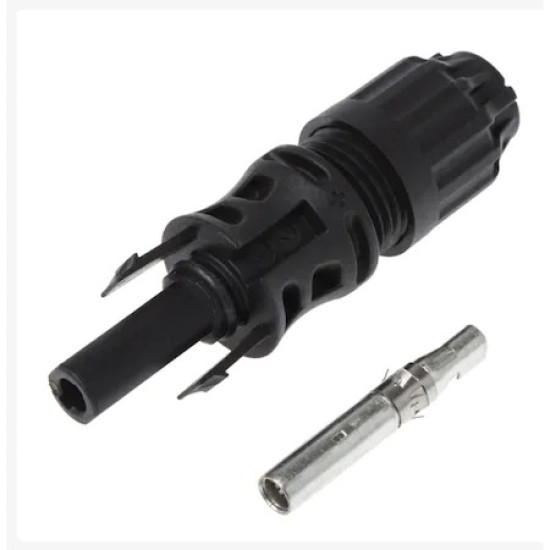
This is the plug that goes into the female socket and, together with it, forms the demountable connection on the direct-current side of the photovoltaic installation. It is fitted onto the solar cable by crimping - that is by pressing the metal contact over the copper wires with a dedicated crimping tool - and by tightening the cable gland. Once mated, the two halves are watertight and mechanically locked, so they cannot be pulled apart by mistake and no water gets into them.
The electrical characteristics are the same as on the female version, because the two always work as a pair: 1500 V DC rated voltage and a current that depends on the thickness of the cable, roughly 32 A at 2.5 mm², 42 A at 4 mm² and 47 A at 6 mm². Once mated, the assembly has an IP68 protection rating, that is it withstands immersion in water at 1 metre for one hour, and the temperature range goes from -40 °C to +85 °C, so it withstands both the winter frost and the roof heated up in summer. The materials resist ultraviolet light and ammonia. For fitting you need a compatible crimping tool and two assembly spanners for the cable gland; without them, the declared tightness is not guaranteed.
MC4-Evo 2 connector in the male version, plug with contact pin (Staubli coding PV-KST4-EVO 2). Rated voltage 1500 V DC on the TUV and UL certifications, rated impulse voltage 16 kV; TUV rated current about 32 A at 2.5 mm², 42 A at 4 mm², 47 A at 6 mm², with versions for large cross-sections up to about 69 A at 10 mm². Ambient temperature -40...+85 °C (TUV) and -40...+90 °C (UL), upper limit temperature 115 °C, IP68 (1 m, 1 h) in the mated state. Contact through the MULTILAM louvre band, with several contact points in parallel and a low contact resistance that is stable over time - a determining factor for avoiding local overheating and electric arcing; locking according to IEC 62852, with disconnection only using the assembly spanner.
Who it suits
Suitable for anyone making or repairing direct-current wiring in photovoltaic installations who needs the male half of the connection; it is always ordered together with the female version.
Terms explained
- Cable gland: The nut at the end of the connector that tightens onto the cable sheath and prevents water ingress and the wire being pulled out.
- Electric arc: A continuous spark that appears at a loosened contact in direct current; it produces great heat and is one of the frequent causes of fire in photovoltaic installations.
- IEC 62852: The standard for photovoltaic connectors; it requires, among other things, that the connection cannot be undone without a tool.
Technical specifications
| Type | MC4-Evo 2, stecher tata (cuplaj de cablu) |
|---|
| Rated voltage | 1500 V DC (TUV si UL) |
|---|
| Rated impulse voltage | 16 kV |
|---|
| Rated current (TUV) | cca. 32 A la 2,5 mm2 / 42 A la 4 mm2 / 47 A la 6 mm2 |
|---|
| Protection rating (mated) | IP68 (1 m, 1 h) |
|---|
| Ambient temperature | -40...+85 °C (TUV); -40...+90 °C (UL) |
|---|
| Upper limit temperature | 115 °C |
|---|
| Accepted cable cross-sections | 2,5 / 4 / 6 / 10 mm2, in functie de varianta |
|---|
| Contact technology | Contact lamelar MULTILAM |
|---|
| Locking system | Zavorare cu deblocare numai cu unealta (IEC 62852) |
|---|
Recommended applications
- Terminating solar cables on the DC side of the photovoltaic installation
- Making extension leads and string cables
- Connecting panels in series and to DC junction boxes
- Repairs and connector replacements in installations already in service
Technical details
Series-level specifications — valid for the product family
The MC4-Evo 2 connector in the male version (plug with contact pin, coding PV-KST4-EVO 2 at Staubli) forms the mating pair with the female socket and is fitted onto the solar cable by crimping and tightening the cable gland. Together, the two halves make a demountable, watertight and mechanically locked DC connection.
The electrical characteristics are identical to those of the female version: 1500 V DC rated voltage on the TUV and UL certifications, rated impulse voltage 16 kV and a rated current depending on the cable cross-section, around 32 A at 2.5 mm2, 42 A at 4 mm2 and 47 A at 6 mm2 in the TUV certification, with versions for large cross-sections reaching about 69 A at 10 mm2. The ambient temperature range is -40...+85 °C (TUV) and -40...+90 °C (UL), with an upper limit temperature of 115 °C.
In the mated state the assembly reaches the IP68 protection rating (1 m, 1 h). Contact is made through the MULTILAM louvre band, which provides several contact points in parallel and keeps the contact resistance low and stable in the long term, a determining factor for avoiding local overheating and electric arcing in DC installations. The materials are resistant to UV and ammonia, and the locking system complies with IEC 62852, disconnection being possible only with the assembly spanner.
It is supplied and used as a pair with the female connectors, for making extensions, the links between strings and the inverter inputs. Crimping is done with a compatible crimping tool, and the cable gland is tightened with two assembly spanners in order to guarantee the declared tightness.