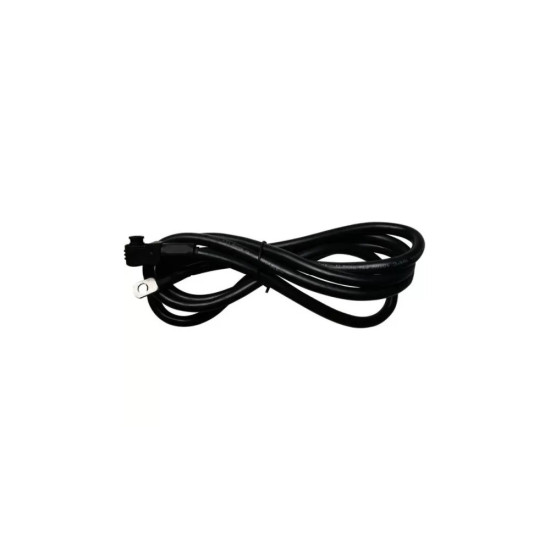
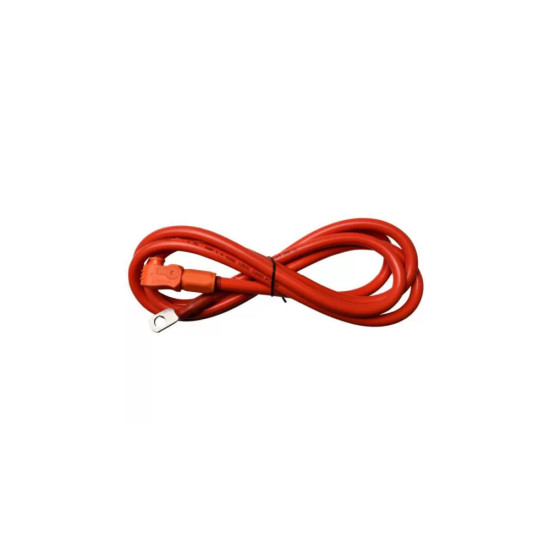
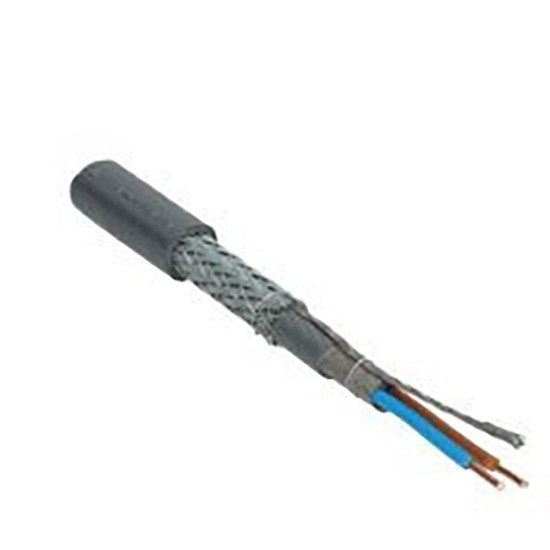
For current to flow between a battery and an inverter, two thick cables are needed: one on the plus and one on the minus. The kit contains exactly this pair, made ready at the factory for the Pytes E-BOX-48100R battery, with the ends already fitted at both extremities. The installer no longer presses terminals on site, and the colour coding between positive and negative reduces the risk of connecting the polarity wrongly.
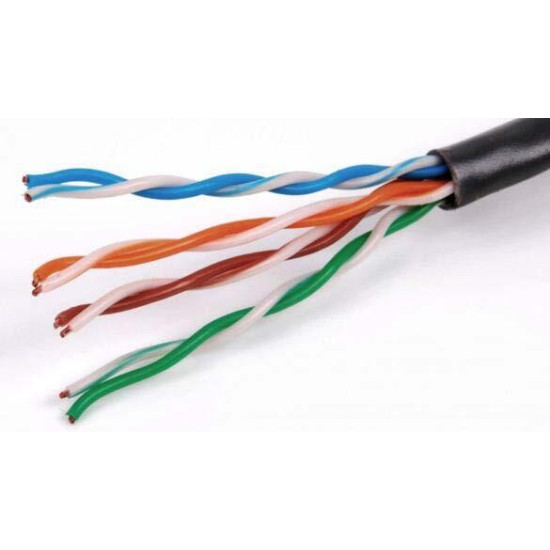
The E-BOX-48100R battery is a lithium iron phosphate (LiFePO4) module of 51.2 V and 100 Ah, that is 5.12 kWh of stored energy, with a declared service life of over 6000 cycles at 90% depth of discharge, which means, roughly, over 16 years at one full cycle per day. The cables in the kit have the usual cross-section of 25 mm² (4 AWG), sized for the operating current of such a 100 Ah module. One end goes into the battery terminal through an Amphenol Surlok connector, which couples with mechanical locking, and the other ends in a ring terminal, for the bolt on the inverter, on the busbar or on the DC isolator. An undersized cable would heat up and lose voltage along the route, which can upset the battery's charging algorithm; the kit is calculated precisely for the usual distance between the rack and the inverter. Note that these cables carry only the current: the data exchange between the battery and the inverter is done separately, through a network cable with RJ45 connectors.
Set made of two prefabricated power cables, positive and negative, with an Amphenol Surlok terminal on the battery side and a ring terminal on the side of the inverter, the busbar or the DC isolator; usual cross-section 25 mm² (4 AWG), system voltage 51.2 V DC nominal. Compatible with the Pytes E-BOX-48100R module, LiFePO4 100 Ah / 5.12 kWh, over 6000 cycles at 90% depth of discharge. The factory-made terminals eliminate on-site crimping and keep the contact resistance at low and repeatable values, with a voltage drop within limits acceptable for the correct operation of the charging algorithm. Battery-inverter communication is achieved separately, on an RJ45 cable, CAN or RS485 protocol.
Who it suits
Suited to those commissioning or extending a 48 V residential storage system with Pytes E-BOX-48100R modules and who want ready-made power links, not ones crimped on site.
Terms explained
- LiFePO4: Type of lithium iron phosphate battery, valued for safety and for the large number of charging cycles.
- Ring terminal: A cable end in the shape of a ring, which is bolted to the inverter terminal or to the busbar.
- DC busbar: The metal part to which several batteries are connected, so that from there a single link goes to the inverter.
Technical specifications
| Purpose | Baterie Pytes E-BOX-48100R, legatura la invertor sau bara DC |
|---|
| Contents | Pereche de cabluri de putere (pozitiv si negativ) |
|---|
| Battery-side terminal | Conector Amphenol Surlok |
|---|
| Inverter-side terminal | Papuc inelar |
|---|
| Usual conductor cross-section | 25 mm2 (4 AWG) |
|---|
| System voltage | 51,2 V DC nominal |
|---|
| Compatible battery | Pytes E-BOX-48100R, 100 Ah / 5,12 kWh LiFePO4 |
|---|
| Communication | Separat, cablu RJ45 pe CAN/RS485 |
|---|
Recommended applications
- Connecting the Pytes E-BOX-48100R battery to a hybrid inverter
- Linking the battery modules to the DC busbar in a rack
- Commissioning 48 V residential storage systems
- Replacing damaged power cables in an existing system
Technical details
Series-level specifications — valid for the product family
The kit contains the power cables needed to connect a Pytes E-BOX-48100R battery module to the hybrid inverter or to the DC busbar. The set is made of two cables, one for the positive pole and one for the negative pole, prefabricated and terminated at the factory, so that the installer no longer performs crimping on site.
On the battery side the cables are fitted with Amphenol Surlok type connectors, the terminal used by the Pytes batteries of the E-BOX series, which ensures a contact with low resistance and mechanical locking. On the inverter side the cables end in ring terminals, for fixing to the inverter terminals, to the busbar or to the DC isolator. The usual conductor cross-section is 25 mm2 (4 AWG), sized for the operating current of a 100 Ah module.
The E-BOX-48100R battery is a LiFePO4 module of 51.2 V and 100 Ah, respectively 5.12 kWh, with a service life of over 6000 cycles at 90% depth of discharge. The cables in the kit are sized for the rated current of this module and for the typical distance between the rack and the inverter, keeping the voltage drop within limits acceptable for the correct operation of the charging algorithm.
The positive-negative colour coding and the pre-installed terminals reduce the risk of polarity reversal, and communication between the battery and the inverter is achieved separately, through a network cable with RJ45 connectors, on CAN or RS485 protocol.