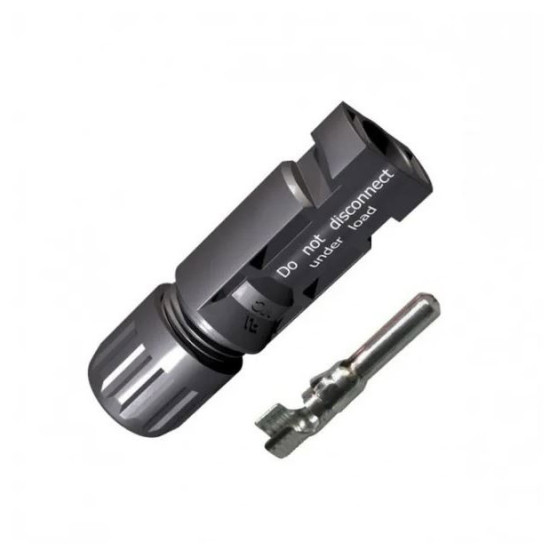
This is the male half of the standard plug used in photovoltaics: the part that carries the metal pin and goes into the female connector. It is fitted to the end of a solar cable by crimping the contact onto the conductor, pushing it into the plastic body until it locks in its seat and tightening the gland, which seals and takes the pulling force of the cable. The gland is sized for cable with an outer diameter of 5-6 mm, that is for the ordinary solar cable of 4 mm² and 6 mm² of the H1Z2Z2-K type.
Locking into the female connector is done by a latch, with an audible click that confirms the joint is complete. Releasing requires pressing the side tabs, usually with a dedicated MC4 key, precisely so that nobody can accidentally disconnect a circuit under load. It is sold per piece, which makes it useful for the spot replacement of a single end, for making an extension lead exactly to the length of the run or for completing an incomplete set. Even when not mated, the contact remains protected against touch, so the part can lie on the roof without risk before the final connection.
Male photovoltaic connector compatible with MC4, 4 mm contact system, crimped, latch locking with release only by tool (MC4 key), touch protection IP2X in the unmated state. Crimping is done with the pliers corresponding to the cross-section and type of contact, on stranded tinned copper cable specific to photovoltaics. Being a generic MC4-compatible product, the certified electrical parameters, voltage 1000 V or 1500 V DC and rated current, depend on the actual manufacturer of the batch. Both halves of a joint must be of the same type and manufacturer, because mating between different brands is not covered by IEC 62852 certification.
Who it suits
Suitable for anyone terminating a solar cable on the polarity that requires a male connector: spot repair, made-to-order extension lead or completing a connector set.
Terms explained
- Latch: The click locking system that keeps the plug mated; it is released only by pressing the side tabs.
- H1Z2Z2-K: The code of the standard solar cable, with insulation resistant to sun, heat and cold, used on the roof.
- IEC 62852: The international standard for photovoltaic connectors; it covers only joints between parts from the same manufacturer.
Technical specifications
| Type | Conector fotovoltaic tata, compatibil MC4 |
|---|
| Contact system | Diametru 4 mm, contact sertizat |
|---|
| Accepted cable outer diameter | 5 - 6 mm |
|---|
| Usual conductor cross-section | 4 - 6 mm2 (cablu solar H1Z2Z2-K) |
|---|
| Locking system | Clichet cu decuplare numai cu scula (cheie MC4) |
|---|
| Assembly | Sertizare contact + insurubare presetupa pentru etansare si descarcare de tractiune |
|---|
| Touch protection (unmated) | IP2X |
|---|
Recommended applications
- Terminating the solar cable end on the polarity that requires a male connector
- Spot repair of a damaged connector
- Making solar cable extension leads to a custom length
- Completing connector sets in residential and off-grid installations
Technical details
Generic product — standard specifications
The MC4-compatible male connector is the coupling half that carries the 4 mm contact pin and goes into the female connector. Assembly involves crimping the contact onto the conductor of the photovoltaic cable, inserting it into the insulating body until it locks in its seat and tightening the threaded gland, which ensures sealing and takes the mechanical pulling force. The gland covers cable with an outer diameter of 5-6 mm, that is in practice the solar cable of 4 mm2 and 6 mm2 of the H1Z2Z2-K type.
Locking into the female connector is done with a latch, with an audible click on engagement. Release can be done only by pressing the side tabs, usually with a dedicated MC4 key, precisely in order to avoid the accidental disconnection of a DC circuit under load. The contact remains protected against touch even when the connector is not mated.
The product is sold individually, which allows the spot replacement of a single end, the making of extension leads to the exact length required by the run or the completion of an incomplete set. Being a generic MC4-compatible product, the certified electrical parameters - voltage 1000 V or 1500 V DC, rated current - depend on the actual manufacturer of the batch.
During assembly, the contact is crimped with the pliers suitable for the cross-section and type of contact, not with universal pliers, and the cable must be of stranded tinned copper, specific to photovoltaics. Both halves of a joint must be of the same type and manufacturer, because mating between different brands is not covered by IEC 62852 certification.