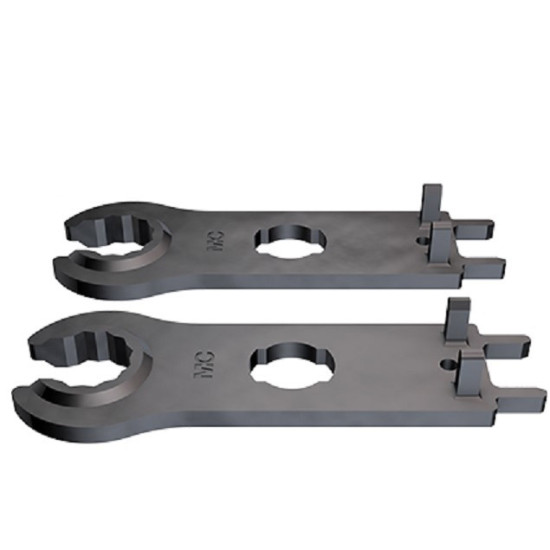
This is the tool with which MC4 connectors are assembled and disconnected, the plugs through which the panels are connected to each other and to the inverter. Once coupled, these plugs lock by themselves and can no longer be pulled apart by hand: it is a safety measure, not a defect, because a panel circuit must not be opened by mistake while it is live. The wrench presses the locking clips simultaneously and releases the pair, cleanly and without straining the cable.
It has three uses. It tightens the gland, that is the nut that seals the cable entry into the connector and prevents it from being pulled out. It pre-tightens the connector body: one wrench holds against, the other turns, so that the effort does not reach the cable. And it unlocks pairs that are already coupled, which is why two are always used and it is usually sold as a set. It is the original Staubli tool, the same brand as the MC4 connectors, so the wrench opening fits exactly on the hexagons of the plug.
PV-MS wrench, Staubli code 32.6024 (formerly Multi-Contact), open-end wrench calibrated on the hexagons of the MC4 and MC4-Evo 2 connectors, with pins on the rear side for actuating the locking latch. According to the Staubli assembly instructions, open-end wrenches are intended exclusively for pre-tightening; the final torque is applied with a dedicated torque tool, in order to guarantee the sealing and mechanical strength values from the connector datasheet. Disconnection possible only with a tool corresponds to the IEC 62852 requirement.
Who it suits
Necessary for anyone who installs or maintains MC4 connectors, from making extensions to service interventions on the direct current side of an installation.
Terms explained
- Cable gland: The nut at the end of the connector that tightens on the cable sheath; it provides the water seal and prevents the wire from being pulled out of the plug.
- Pre-tightening: The initial tightening, by hand and with the wrench, until the parts sit well together; the final tightening, at the exact value, is done separately, with a special tool.
- Torque tool: A tool that stops by itself at a preset tightening force, so that you tighten neither too loosely nor to the point of damaging the part.
Technical specifications
| Product code | PV-MS, 32.6024 (Staubli / Multi-Contact) |
|---|
| Type | Cheie fixa deschisa pentru montaj conectori PV |
|---|
| Compatibility | Conectori MC4 si MC4-Evo 2 |
|---|
| Functions | Strangerea presetupei, prestrangerea conectorului, deblocarea perechilor cuplate |
|---|
| Unlocking | Prin pinii de pe partea din spate a cheii |
|---|
| Method of use | Se foloseste in pereche (o cheie pentru contra) |
|---|
| Assembly note | Doar pentru prestrangere; cuplul final se da cu scula dinamometrica |
|---|
Recommended applications
- Assembling MC4 connectors on solar cable, when making extensions
- Tightening the glands to ensure IP68 sealing
- Unlocking and separating coupled MC4 connector pairs
- Service and maintenance interventions on the DC side of photovoltaic installations
Technical details
Specifications confirmed from the manufacturer's datasheet
The PV-MS assembly wrench, Staubli product code 32.6024 (formerly Multi-Contact), is the original tool for assembling and opening the MC4 and MC4-Evo 2 photovoltaic connectors. It has the shape of an open-end wrench with an opening calibrated on the connector hexagons and has pins on the rear side, used for actuating the locking latch.
The tool fulfils three distinct functions. The first is tightening the cable gland, the operation that ensures the declared sealing of the connector and the strain relief. The second is pre-tightening the connector body: the connector is placed in the opening of one wrench, and the second wrench is used to hold against, performing the screwing movement without straining the cable. The third is unlocking a pair of coupled and latched connectors, by pressing the locking clips simultaneously, which corresponds to the IEC 62852 requirement that disconnection be possible only with the tool.
For this reason the wrenches are used in pairs and are frequently sold as a set of two pieces. According to the Staubli assembly instructions, open-end wrenches are intended only for pre-tightening; the final tightening torque is achieved with a dedicated torque tool, in order to guarantee the sealing and mechanical strength values from the connector datasheet.
The tool is indispensable for interventions in installations under DC voltage, where pulling coupled connectors by hand is both ineffective and dangerous, and for any maintenance work that involves separating and remaking the string connections.