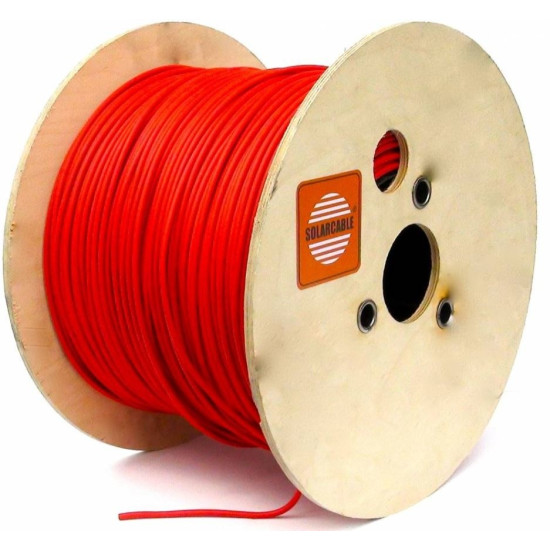
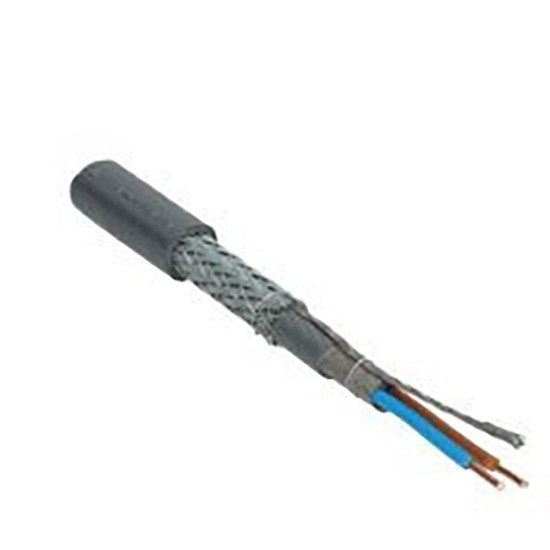
This is the red version of the 4 mm² solar cable, supplied on a 500 metre drum and used by convention for the positive pole of the panel string. Together with the black drum it forms the complete set for wiring an installation, with the polarity visibly marked along the whole route. The colour changes nothing electrically, but it makes the installation easy to read for anyone working on it years later.
The 500 m format is for volume work: exactly the length needed for each string is cut, less material is wasted and fewer joints are made along the route. The cable covers both 1000 V and 1500 V direct current installations, so it does not limit the design. It withstands 90 °C on the conductor in continuous operation and goes down to -40 °C, and the insulation resists sun, ozone, mineral oils, greases and chemical agents, standing water and submersion. In a fire it does not propagate the flame and releases no halogenated gases. Both colours have the same ageing characteristics, so the installation does not have one pole degrading faster than the other.
TOPSOLAR PV H1Z2Z2-K, tinned electrolytic copper conductor, class 5 (flexible) according to EN 60228, halogen-free cross-linked rubber insulation and sheath; 1.5/1.5 (1.8) kV DC and 1/1 kV AC. TUV Rheinland certification to EN 50618 and AENOR to IEC 62930, plus UTE C 32-502, CE and RoHS; CPR class Cca-s1b, d2, a1 with flame non-propagation to EN 60332-1-2. Conductor temperature 90 °C continuous, 120 °C cumulated 20,000 h, 250 °C maximum 5 s on short circuit, minimum service temperature -40 °C; AD7+ immersion and AD8 submersion resistance, minimum bending radius 4 × the outer diameter for cables up to 8 mm.
Who it suits
Suitable for installers and distributors who wire entire installations, residential, commercial or parks, and buy the red-black pair on drums.
Terms explained
- Positive pole: One of the two wires of the direct current circuit; marking it in red prevents reversing the connections during installation or a later intervention.
- AD7+ immersion and AD8 submersion: Classifications confirming that the wire resists temporarily accumulated water and even standing under water, useful in trenches or on roofs where puddles form.
- MC4 connector: The standard plug through which the panels are connected to each other and to the inverter; it is fitted to the end of the cable cut to length.
Technical specifications
| Conductor cross-section | 4 mm2 |
|---|
| Drum length | 500 m |
|---|
| Colour | Rosu |
|---|
| Cable type | TOPSOLAR PV H1Z2Z2-K |
|---|
| Rated DC voltage | 1,5/1,5 (1,8) kV |
|---|
| Rated AC voltage | 1/1 kV |
|---|
| Conductor | Cupru cositorit, clasa 5 (flexibil) |
|---|
| Insulation and sheath | Cauciuc reticulat fara halogeni (LSZH) |
|---|
| Maximum conductor temperature | 90 °C (120 °C timp de 20.000 h) |
|---|
| Short-circuit temperature | 250 °C, max. 5 s |
|---|
| Minimum service temperature | -40 °C |
|---|
| Standards | EN 50618, IEC 62930, UTE C 32-502 |
|---|
| Certifications | CE, TUV Rheinland, AENOR, RoHS |
|---|
| CPR class | Cca-s1b, d2, a1 |
|---|
| UV and ozone resistance | Conform EN 50618 / IEC 62930 |
|---|
Recommended applications
- Wiring the positive pole of photovoltaic strings, on a site scale
- Series production of DC extension leads with MC4 connectors
- Residential and commercial photovoltaic installations and parks
- Working stock for installation companies and distributors
Technical details
Specifications confirmed from the manufacturer's datasheet
The red 4 mm2 version of the TOPSOLAR PV H1Z2Z2-K photovoltaic cable, supplied on a 500 m drum and conventionally used for the positive pole. The conductor is of tinned electrolytic copper, class 5 (flexible) according to EN 60228, and the insulation and sheath are of halogen-free cross-linked rubber.
The cable is TUV Rheinland certified to EN 50618 and AENOR certified to IEC 62930, with a rated voltage of 1.5/1.5 (1.8) kV DC and 1/1 kV AC, covering both 1000 V and 1500 V DC installations. The maximum conductor temperature is 90 °C in continuous operation and 120 °C for 20,000 cumulated hours, with resistance to 250 °C for a maximum of 5 seconds on short circuit and a minimum service temperature of -40 °C.
The material resists UV and ozone to EN 50618, AD7+ immersion and AD8 submersion, mineral oils, greases and chemical agents. The reaction-to-fire class according to CPR is Cca-s1b, d2, a1, with flame non-propagation to EN 60332-1-2 and no halogenated gases. The minimum bending radius is 4 times the outer diameter for cables up to 8 mm.
Bought together with the black drum, it forms the complete set for the DC wiring of an installation, with clear polarity marking along the whole route and the same ageing characteristics on both polarities. The 500 m format reduces material waste and the number of joints.