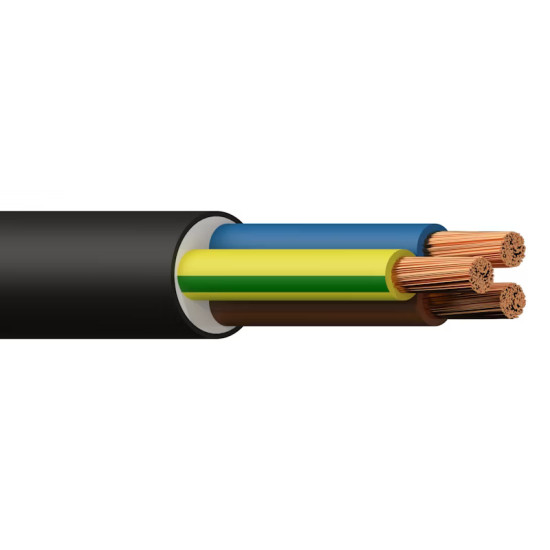
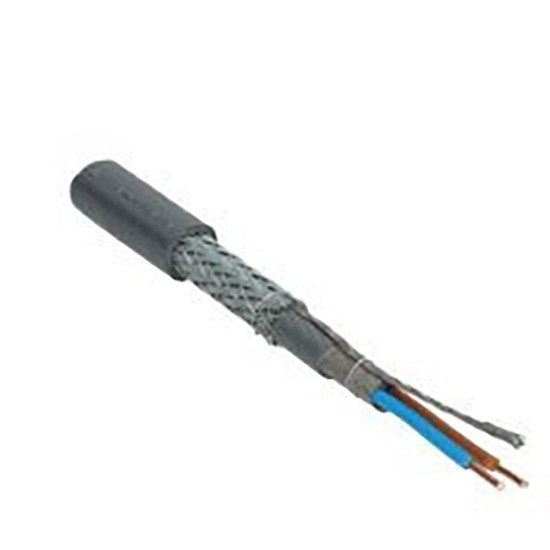
This is the three-phase alternating current cable in the variant with thicker wires. The five conductors cover the three phases, the neutral and the earth, and the outer sheath allows installation outdoors, buried or in conduit. Thicker wires mean more current carried and less voltage lost along the way.
The 6 mm² cross-section on each path is chosen for higher-power three-phase inverters or for long runs, where the 4 mm² variant would lead to a voltage drop above the permitted limit. The cable withstands 90 °C on the conductor in continuous operation and remains functional down to -40 °C, but it is laid only above 0 °C. It can be buried directly, pulled through conduit or through a duct and installed outdoors without additional protection, including in damp and submerged conditions. The sheath does not propagate flame, has a low halogen content and resists oils and chemical agents well, which makes it suitable also for technical rooms or industrial halls. It is commonly used between the photovoltaic panel board and the main distribution board, as well as for high-power three-phase charging stations.
RV-K 0.6/1 kV in accordance with IEC 60502-1 and UNE 21123-2, 5 × 6 mm², class 5 copper (flexible), XLPE insulation, black flexible PVC sheath. Maximum conductor temperature 90 °C in continuous operation, 250 °C for a maximum of 5 s in short circuit, minimum service temperature -40 °C in fixed and protected installations, minimum laying temperature 0 °C. Flame non-propagation EN 60332-1, CPR class Eca, water resistance AD8 submersion, minimum bending radius 5 × the outer diameter in fixed installations.
Who it suits
Suitable for large residential and commercial photovoltaic systems, with a high-power three-phase inverter or with a long distance between the photovoltaic board and the main board.
Terms explained
- Voltage drop: The voltage lost along the length of the cable; if it exceeds the design limit, the equipment receives less voltage than it needs and the yield falls.
- Direct burial: The cable can be laid in a trench without conduit or other protection, because its sheath resists moisture and the stresses in the ground.
- CPR class Eca: The European fire classification level for common power cables, which confirms that the flame does not propagate along the cable.
Technical specifications
| Cable type | RV-K 0,6/1 kV (IEC 60502-1, UNE 21123-2) |
|---|
| Number and cross-section of conductors | 5 x 6 mm2 |
|---|
| Conductor | Cupru, clasa 5 (flexibil) |
|---|
| Insulation | XLPE (polietilena reticulata) |
|---|
| Outer sheath | PVC flexibil, negru |
|---|
| Maximum conductor temperature | 90 °C |
|---|
| Short-circuit temperature | 250 °C, max. 5 s |
|---|
| Minimum service temperature | -40 °C (fix, protejat) |
|---|
| Minimum laying temperature | 0 °C |
|---|
| Fire behaviour | Nepropagarea flacarii EN 60332-1; clasa CPR Eca |
|---|
| Water resistance | AD8 submersie |
|---|
| Minimum bending radius | 5 x diametrul exterior |
|---|
Recommended applications
- AC connection of high-power three-phase inverters
- Link between the photovoltaic board and the main distribution board
- Supply of high-power three-phase charging stations
- Buried power circuits in commercial and industrial installations
Technical details
Series-level specifications — valid for the product family
Low-voltage power cable of type RV-K in accordance with IEC 60502-1 and UNE 21123-2, with a nominal voltage of 0.6/1 kV, in a configuration with five conductors of 6 mm2, intended for three-phase circuits with neutral and protective conductor. The conductors are of class 5 copper (flexible), insulated with XLPE and protected by an outer sheath of flexible PVC.
The 6 mm2 cross-section on each path covers higher-power three-phase inverters or long runs, where the 4 mm2 variant would lead to a voltage drop above the permitted limit. The XLPE insulation withstands 90 °C on the conductor in continuous operation and 250 °C for a maximum of 5 seconds in short circuit, with a minimum service temperature of -40 °C in fixed and protected installations and a minimum laying temperature of 0 °C.
The PVC sheath does not propagate flame in accordance with EN 60332-1, has a low halogen content and resists oils and chemical agents well. The cable supports direct burial, laying in conduit or in a duct and outdoor installation without additional protection, including in humid and submerged conditions (AD8). The minimum bending radius in fixed installations is 5 times the outer diameter, and the reaction-to-fire class according to CPR is Eca.
It is used for the AC connection of three-phase inverters in large residential and commercial photovoltaic systems, for the link between the photovoltaic board and the main board and for supplying high-power three-phase charging stations.