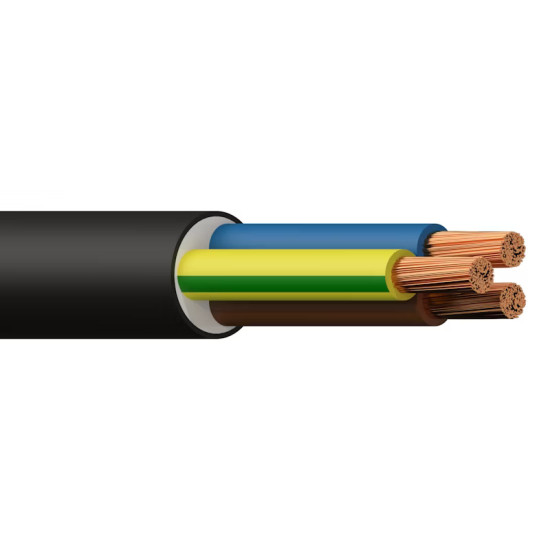
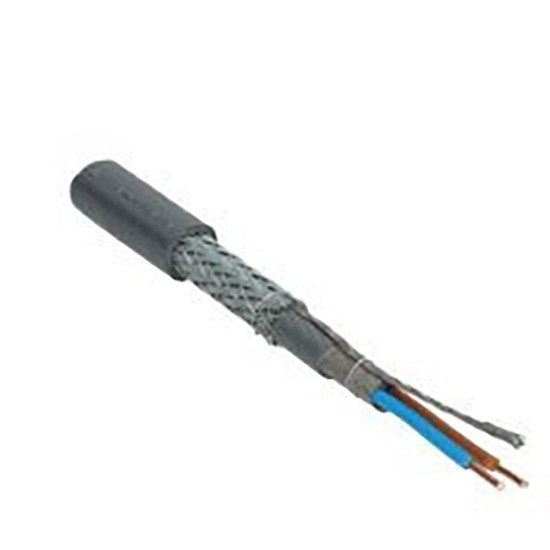
It is the alternating current cable, that is the ordinary house wire, in a robust version, designed for outdoors. It has three conductors inside, live, neutral and earth, plus a sheath that protects it from moisture, sun and knocks. It is used after the inverter, where the energy produced by the panels has already become the current that supplies the sockets.
With three conductors of 4 mm² it covers the single-phase link between the inverter and the distribution panel or the connection point. It can be buried directly in the ground, pulled through a conduit or mounted exposed outdoors, without additional protection, and it resists even if it ends up under water. The XLPE insulation withstands 90 °C on the conductor in permanent duty, more than a cable with PVC insulation, and in service it goes down to -40 °C; laying, however, is done only above 0 °C, a temperature measured on the surface of the cable. The flexible conductor is pulled easily along routes with many changes of direction and is connected comfortably in crowded panels. The usual colour code is blue for neutral, brown for live and green-yellow for earth.
RV-K 0,6/1 kV according to IEC 60502-1 and UNE 21123-2, 3 × 4 mm², class 5 copper (flexible), XLPE insulation, outer sheath of black flexible PVC. Maximum conductor temperature 90 °C in permanent duty and 250 °C for a maximum of 5 s at short circuit; minimum service temperature -40 °C in fixed and protected installations, minimum laying temperature 0 °C. Flame non-propagation according to EN 60332-1, reduced halogen content, CPR class Eca, water resistance AD8 submersion. Minimum bending radius in fixed installations 5 × the outer diameter, for cables up to 50 mm.
Who it suits
Suitable for a single-phase photovoltaic system of small power, where the inverter has to be connected to the house panel through an outdoor route, buried or pulled through a conduit.
Terms explained
- Alternating current (AC): The form of current in the house sockets; the panels produce direct current, and the inverter turns it into alternating current, which travels further through this cable.
- XLPE: A type of plastic treated so as to withstand higher temperatures than ordinary PVC, which allows the conductor to carry more current without overheating.
- AD8 submersion: Classification that confirms a cable can stay under water without deteriorating, useful where the route passes through trenches or areas that flood.
Technical specifications
| Cable type | RV-K 0,6/1 kV (IEC 60502-1, UNE 21123-2) |
|---|
| Number and section of conductors | 3 x 4 mm2 |
|---|
| Conductor | Copper, class 5 (flexible) |
|---|
| Insulation | XLPE (cross-linked polyethylene) |
|---|
| Outer sheath | Flexible PVC, black |
|---|
| Conductor colours | Blue, brown, green-yellow |
|---|
| Maximum conductor temperature | 90 °C |
|---|
| Short circuit temperature | 250 °C, max. 5 s |
|---|
| Minimum service temperature | -40 °C (fixed, protected) |
|---|
| Minimum laying temperature | 0 °C |
|---|
| Fire behaviour | Flame non-propagation EN 60332-1; CPR class Eca |
|---|
| Water resistance | AD8 submersion |
|---|
| Minimum bending radius | 5 x the outer diameter |
|---|
Recommended applications
- Single-phase AC link from the inverter to the distribution panel
- Supply circuits buried or laid in a conduit, outdoors
- Supply of auxiliary equipment in photovoltaic installations
- Industrial installations and building sites, on routes with many changes of direction
Technical details
Series-level specifications — valid for the product family
Low-voltage power cable of the RV-K type, made according to IEC 60502-1 and UNE 21123-2, with a rated voltage of 0,6/1 kV. It contains three conductors of 4 mm2 of class 5 copper (flexible), individually insulated with cross-linked polyethylene (XLPE) and protected by an outer sheath of flexible PVC, usually black. The usual coding of the conductors for the three-core version is blue, brown and green-yellow, that is live, neutral and protective conductor.
The XLPE insulation allows a maximum conductor temperature of 90 °C in permanent duty and 250 °C for a maximum of 5 seconds at short circuit, values superior to cables with PVC insulation. The minimum service temperature is -40 °C in fixed and protected installations, and the minimum laying temperature, measured on the surface of the cable, is 0 °C. The PVC sheath does not propagate the flame according to EN 60332-1 and has a reduced halogen content.
The cable can be buried directly, laid in a conduit or mounted outdoors without additional protection and it withstands humid conditions, including submersion (AD8). The minimum bending radius for fixed installations is 5 times the outer diameter for cables up to 50 mm. The reaction-to-fire class according to CPR is Eca. The high flexibility given by the class 5 conductor simplifies pulling along routes with many changes of direction and in narrow spaces.
In photovoltaic installations the 3x4 mm2 version is used on the alternating current side, for the single-phase link between the inverter and the distribution panel or between the panel and the connection point, as well as for supplying auxiliary equipment mounted outdoors.