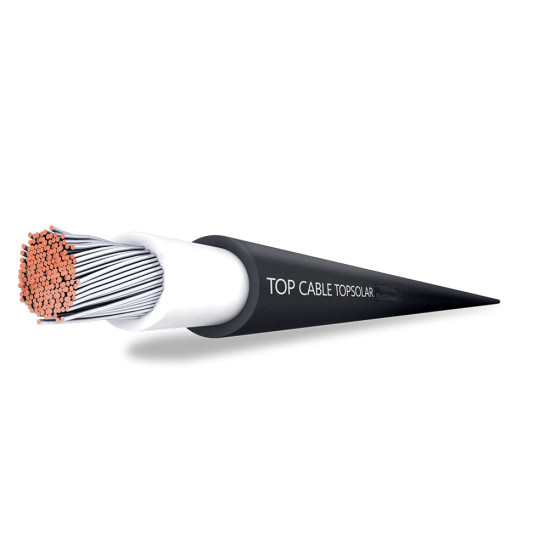
It is the cable that carries the current from the panels to the inverter, in the version with a thicker conductor. A thicker wire opposes less resistance, just as a wider pipe carries water more easily, so less energy is lost along the way. The black variant marks, by convention, the minus (negative) pole of the panel string.
The 6 mm² cross-section is chosen when the distance from the panels to the inverter is large or when the modules have a high current, so that voltage is not lost along the route. It withstands 90 °C in continuous operation and goes down to -40 °C, so it covers both the roof heated in summer and harsh winters. The insulation does not degrade in the sun, withstands standing water and even submersion, and in a fire it does not propagate the flame and does not release halogenated gases. Being thicker than the 4 mm² variant, it requires MC4 connectors with a gland suited to the larger outer diameter, otherwise the sealing is not achieved correctly and the protection warranty of the joint is no longer valid.
TOPSOLAR PV H1Z2Z2-K, conductor of tinned electrolytic copper class 5 (flexible) according to EN 60228, insulation and sheath of halogen-free cross-linked rubber; rated voltage 1.5/1.5 (1.8) kV DC and 1/1 kV AC. TUV Rheinland certification according to EN 50618 and AENOR according to IEC 62930, plus UTE C 32-502, CE and RoHS. Maximum conductor temperature 90 °C continuous and 120 °C cumulated 20,000 h, 250 °C maximum 5 s at short circuit, minimum service temperature -40 °C; water resistance AD7+ immersion and AD8 submersion, UV and ozone according to EN 50618 / IEC 62930. CPR class Cca-s1b, d2, a1 with flame non-propagation EN 60332-1-2; minimum bending radius 4 × the outer diameter up to 8 mm and 5 × the diameter between 8 and 12 mm.
Who it suits
Suitable for projects with high current modules, long strings or photovoltaic parks, where the distance to the string box requires limiting the voltage drop below the design threshold.
Terms explained
- Voltage drop: The voltage loss that appears along the length of the wire; the thinner and longer the wire, the less energy reaches the inverter.
- Class 5 (flexible): The conductor is made of many thin twisted wires, not of a single thick wire, so it bends easily and is pulled comfortably along routes with many bends.
- Cable gland: The nut at the end of the connector that tightens onto the cable sheath; it makes the seal and prevents the wire from being pulled out.
Technical specifications
| Conductor cross-section | 6 mm2 |
|---|
| Colour | Black |
|---|
| Cable type | TOPSOLAR PV H1Z2Z2-K |
|---|
| Rated DC voltage | 1,5/1,5 (1,8) kV |
|---|
| Rated AC voltage | 1/1 kV |
|---|
| Conductor | Tinned copper, class 5 (flexible) |
|---|
| Insulation and sheath | Halogen-free cross-linked rubber (LSZH) |
|---|
| Maximum conductor temperature | 90 °C (120 °C for 20.000 h) |
|---|
| Short-circuit temperature | 250 °C, max. 5 s |
|---|
| Minimum service temperature | -40 °C |
|---|
| Standards | EN 50618, IEC 62930, UTE C 32-502 |
|---|
| Certifications | CE, TUV Rheinland, AENOR, RoHS |
|---|
| CPR class | Cca-s1b, d2, a1 |
|---|
| Water resistance | AD7+ immersion, AD8 submersion |
|---|
Recommended applications
- DC wiring for long strings or high current modules
- The link from the string boxes to the inverter in photovoltaic parks
- DC runs where the voltage drop must be limited below the design threshold
- Commercial and industrial photovoltaic installations
Technical details
Specifications confirmed from the manufacturer's datasheet
Single-core photovoltaic cable of 6 mm2 from the TOPSOLAR PV H1Z2Z2-K range, in the black variant for the negative pole. The conductor of tinned electrolytic copper, class 5 (flexible) according to EN 60228, offers a lower ohmic resistance than the 4 mm2 variant, which reduces the voltage drop and the losses on long runs or with strings of high current modules.
The insulation and the sheath are of halogen-free cross-linked rubber. The cable is TUV Rheinland certified according to EN 50618 and AENOR according to IEC 62930, with a rated voltage of 1.5/1.5 (1.8) kV DC and 1/1 kV AC. The maximum conductor temperature is 90 °C in continuous operation and 120 °C for 20,000 cumulated hours, with resistance to 250 °C for a maximum of 5 seconds under short circuit and a minimum service temperature of -40 °C.
The resistance to UV and ozone complies with EN 50618 and IEC 62930, and the water resistance covers AD7+ immersion and AD8 submersion. The reaction to fire class according to CPR is Cca-s1b, d2, a1, with flame non-propagation according to EN 60332-1-2 and without emission of halogenated gases. The minimum bending radius is 4 times the outer diameter for cables of up to 8 mm and 5 times the diameter for those between 8 and 12 mm.
The 6 mm2 cross-section is chosen in projects with high current modules, with long strings or in photovoltaic parks where the distance to the string box requires limiting the voltage drop below the design threshold. It is terminated with MC4 connectors in gland variants compatible with the larger outer diameter of the 6 mm2 cable.