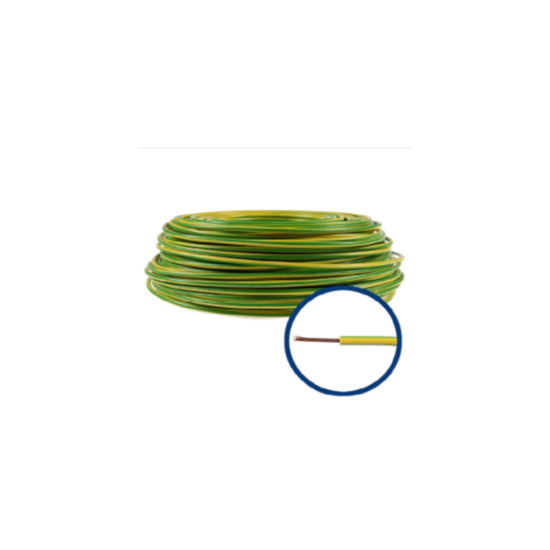
This is the safety wire of the installation: the one that earths all the metal parts on which there should never be any voltage, that is the structure on the roof, the panel frames and the equipment enclosures. If a fault accidentally reaches the metal, the current has a way to leave into the ground, instead of passing through whoever touches that metal. The conductor is flexible, made of numerous thin wires, so it bends easily and is routed comfortably along runs with tight bends, inside the distribution boards.
The 6 mm² cross section is the value usually required for the protective conductor of a photovoltaic structure, so it covers the connections from the mounting structure, from the panel frames and from the inverter enclosures up to the main earthing bar. The insulation is of the halogen-free type (LSZH), which matters in a fire: the material does not sustain the flame, produces much less dense smoke and does not release the corrosive gases that classic PVC insulation releases, a real advantage on runs that pass through technical spaces or through rooms with people. The nominal voltage is 450/750 V, and the conductor withstands 70 °C in continuous operation. It is installed with crimped lugs or with dedicated earthing clamps. By convention, the protective conductor is marked green-yellow, so that it is immediately recognised by any electrician who intervenes later.
Single-core flexible conductor of 6 mm², electrolytic copper class 5 according to EN 60228, insulation of halogen-free thermoplastic compound type Z1 (LSZH), nominal voltage 450/750 V, maximum conductor temperature 70 °C in continuous operation. Fire behaviour: flame non-propagation according to EN 60332-1-2, smoke with reduced opacity according to EN 61034, no halogenated corrosive gases according to EN 60754 / EN 50267. Intended for protective conductors and equipotential bonding connections: metal mounting structure, module frames, inverter enclosures, DC and AC distribution boxes, towards the main earthing bar. Terminations with crimped lugs or dedicated earthing clamps, with green-yellow marking or insulation according to the marking rules of electrical installations.
Who it suits
Suitable for any photovoltaic installation that needs earthing and equipotential bonding connections, especially where the run passes through technical or inhabited spaces.
Terms explained
- Earthing: Connecting the metal parts to the ground, so that a possible fault current leaves into the soil and not through a person.
- LSZH (halogen-free): Insulation that, in a fire, makes little smoke and does not release corrosive gases, unlike PVC.
- Equipotential bonding: Connecting all metal parts to each other, so that no dangerous voltage differences appear between them.
Technical specifications
| Cross section | 6 mm2 |
|---|
| Conductor | Cupru electrolitic, clasa 5 (flexibil), EN 60228 |
|---|
| Insulation type | Compus termoplastic fara halogeni, tip Z1 (LSZH) |
|---|
| Nominal voltage | 450/750 V |
|---|
| Maximum conductor temperature | 70 °C in regim continuu |
|---|
| Fire behaviour | Nepropagarea flacarii EN 60332-1-2 |
|---|
| Emissions in case of fire | Fum redus (EN 61034), fara gaze corozive halogenate (EN 60754 / EN 50267) |
|---|
| Use | Conductor de protectie si de egalizare a potentialelor |
|---|
Recommended applications
- Earthing the metal mounting structure of the photovoltaic panels
- Earthing the panel frames and the inverter enclosures
- Equipotential bonding between DC and AC boards and the main earthing bar
- Protective wiring in electrical boards and technical spaces
Technical details
Generic product — standard specifications
Single-core flexible conductor of 6 mm2 intended for the earthing and equipotential bonding connections of photovoltaic installations. The core is of electrolytic copper, class 5 (flexible) according to EN 60228, made of numerous thin wires, which allows routing along runs with tight bends, inside the boards and along the mounting structures.
The insulation is of halogen-free thermoplastic compound type Z1 (LSZH), with a nominal voltage of 450/750 V and a maximum conductor temperature of 70 °C in continuous operation. In case of fire the material does not propagate the flame according to EN 60332-1-2, releases smoke with reduced opacity according to EN 61034 and does not emit halogenated corrosive gases according to EN 60754 / EN 50267, unlike classic PVC insulations. This characteristic is relevant on runs that cross technical spaces, shared cable trays or rooms with people present.
In photovoltaic installations the 6 mm2 conductor is used for earthing the metal mounting structure, the panel frames, the inverter enclosures and the DC and AC distribution boxes, as well as for the equipotential bonding connections towards the main earthing bar. The 6 mm2 cross section is the value usually required for the protective conductors of the photovoltaic structure.
It is installed with crimped lugs or with dedicated earthing clamps; for identification, the protective conductor must be marked or insulated in the green-yellow combination, according to the marking rules of electrical installations.