Deye
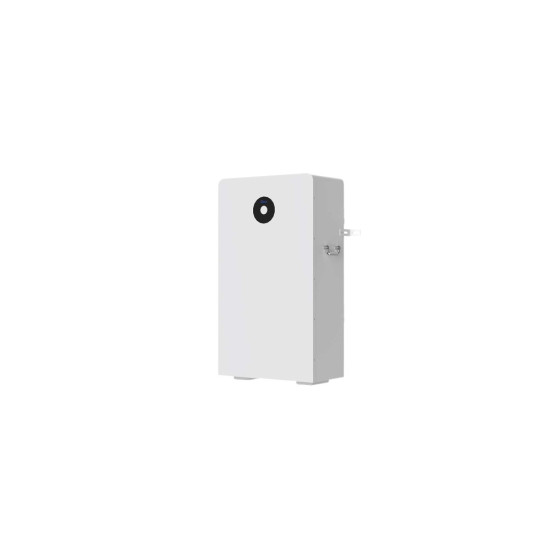
Deye RW-F16 battery, 16 kWh, LiFePo4
Autonomy for a whole evening: 16 kWh, of which 14.4 kWh usable, 160 A continuous and a 300 A peak for appliances that are hard to start.
LV
11.205,83 RON incl. VATexcl. VAT: 9.261,02 RON
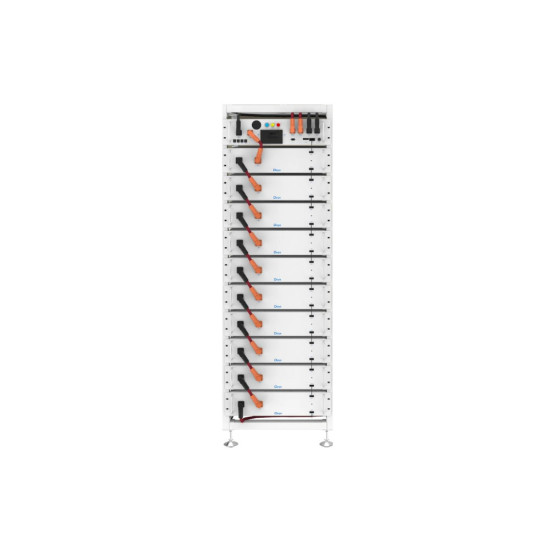
A 76.8 kWh reserve for companies and industrial halls: 10 LiFePO4 modules connected in series at 384 V, which cover consumption peaks and keep critical machinery running during a power cut.
It is a battery cabinet that stores energy when you have plenty of it - from panels or from the grid, in the hours when electricity is cheaper - and gives it back when you need it. The batteries are LiFePO4 type, that is lithium iron phosphate, a chemistry chosen because it heats up slowly and withstands thousands of charges. Ten identical boxes are stacked one on top of the other in a metal cabinet, and above them sits a control unit that supervises them all and talks to the inverter.
The 76.8 kWh result from 10 modules of 7.68 kWh each, enough to cover the evening and night consumption of a commercial building or to keep the important equipment in an industrial hall running for the duration of a power cut. The system normally charges and discharges at 100 A and can go up to 160 A for short peaks, such as motor starts. The manufacturer declares a minimum of 6000 cycles at 90% depth of discharge, which, roughly, means over 16 years at one full cycle per day. Each module weighs about 70 kg, so the assembly is installed indoors, on a floor that supports the weight, and if the energy need grows, modules can be added up to 161.28 kWh.
Configuration: 10 x BOS-A-Pack7.68 in series, 384 V nominal at bank level, modules of 38.4 V / 200 Ah, 601.5 x 520 x 135 mm and about 70 kg each. Rated charge/discharge current 100 A, maximum discharge current 160 A, values valid at cluster level too thanks to the series connection. The BMS performs cell balancing and protection against overvoltage, overcurrent, short circuit and temperature, with CAN 2.0 communication through the BOS-A-PDU-2 control unit (HVB 750V/160A-EU). The series accepts 7-21 modules (53.76-161.28 kWh), IP20 protection rating with indoor mounting, charging at 0...55 degrees C, discharging at -20...55 degrees C, humidity 5-85% RH, maximum altitude 3000 m, sized for inverters in the 50-100 kW class.
Suited to an industrial hall, a farm or a commercial space that works with 50-100 kW Deye inverters and wants to cut consumption peaks, while at the same time having a reserve for the processes that must not stop.
| System energy | 76,8 kWh |
|---|---|
| Configuration | 10 module BOS-A-Pack7.68 x 7,68 kWh, in serie |
| Cell technology | LiFePO4 (LFP) |
| System nominal voltage | 384 V |
| Module voltage / capacity | 38,4 V / 200 Ah |
| Rated charge/discharge current | 100 A |
| Maximum discharge current | 160 A |
| Number of cycles | >= 6000 @ 90% DOD |
| Control unit | BOS-A-PDU-2 (HVB 750V/160A-EU) |
| Communication | CAN 2.0 |
| Protection rating | IP20 |
| Charging / discharging temperature | 0...55 grade C / -20...55 grade C |
| Humidity / altitude | 5-85% RH / max. 3000 m |
10 years
Series-level specifications — valid for the product family
The Deye BOS-A HV 76.8 kWh system is a high-voltage storage cluster made up of 10 BOS-A-Pack7.68 modules of 7.68 kWh each, connected in series, mounted in a rack cabinet together with the BOS-A-PDU-2 control unit. The nominal voltage of the bank is 384 V.
Each module has LiFePO4 cells, nominal voltage 38.4 V and capacity 200 Ah, with dimensions 601.5 x 520 x 135 mm and a mass of about 70 kg. The rated charge and discharge current is 100 A, and the maximum discharge reaches 160 A, values valid at cluster level too thanks to the series connection.
The BMS automatically manages the cycles and cell balancing, with protection against overvoltage, overcurrent, short circuit and temperature, and communicates via CAN 2.0. The declared service life of the modules is a minimum of 6000 cycles at 90% DOD.
The BOS-A series accepts between 7 and 21 modules in series, that is between 53.76 and 161.28 kWh, and the 76.8 kWh configuration sits in the middle range, suitable for inverters in the 50 - 100 kW class. The protection rating is IP20, with indoor mounting, at charging temperatures of 0...55 degrees C and discharging temperatures of -20...55 degrees C, humidity 5 - 85% and altitude of maximum 3000 m.
Autonomy for a whole evening: 16 kWh, of which 14.4 kWh usable, 160 A continuous and a 300 A peak for appliances that are hard to start.
Keeps the energy produced during the day and uses it in the evening: 5.12 kWh, of which 4.6 kWh usable, 19 inch rack format and more than 6000 cycles.
Battery of 5,12 kWh for hybrid inverters on 48 V: over 6000 cycles, 100 A continuous discharge and the possibility of connecting up to 50 modules in parallel.
Modular high-capacity battery, from 9.9 up to 26.4 kWh, designed to cover the evening and the night. 30 A continuous, efficiency above 96%, over 6,000 cycles, IP65.