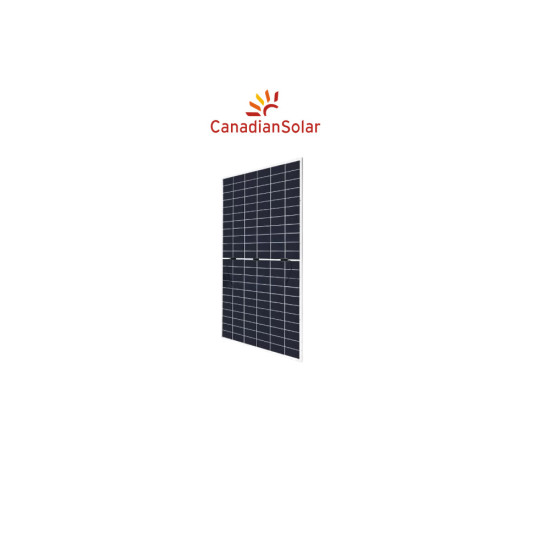
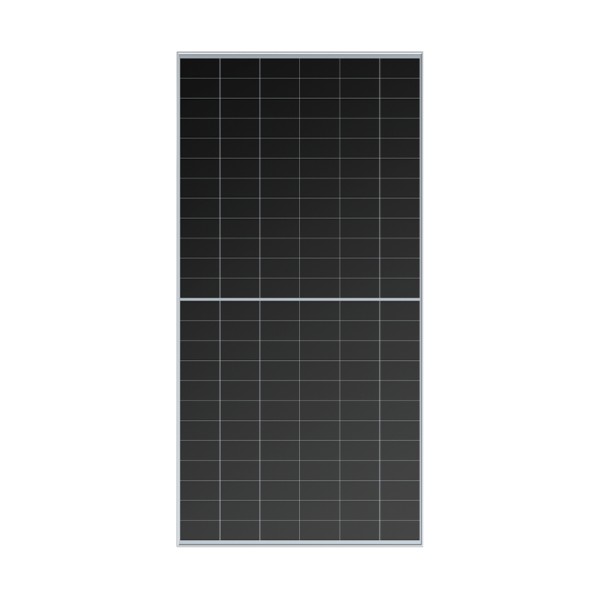
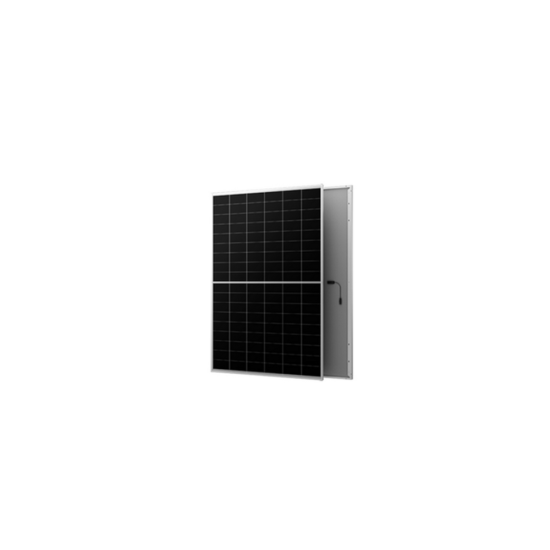
This is a large-format photovoltaic panel, designed for solar parks and industrial roofs, not for the ordinary house. It has glass on both faces and cells that also work with the light reflected from the ground, that is, it is bifacial. The logic of the format is simple: the more power a panel makes, the fewer pieces, fewer fixings, less metal structure and less cable you need for the same power plant.
One module measures 2384 x 1303 x 33 mm - almost the size of a double door - about 3.1 sqm and 37.8 kg, so it must be handled by two people. At 710 W each, as a guide one hundred panels mean 71 kWp laid over about 310 sqm of module surface (calculated from power and dimensions). It withstands 5400 Pa snow load and 2400 Pa wind load, which also covers regions with harsh winters. The warranty is 12 years on the product and 30 years on power, with a declared loss below 1% in the first year and below 0.4% per year afterwards; being N-type cells, the LID degradation of the first months of exposure does not occur.
At STC: 710 W, Voc 48.3 V, Vmp 40.4 V, Isc 18.59 A, Imp 17.59 A, front efficiency 22.9%, 132 N-type TOPCon half-cells (2 x 66). The relatively low working voltage combined with the high current allows long strings at 1500 V DC and reduces the structure and cabling cost (BOS), but an Isc of over 18 A requires checking the current limit on the inverter's MPPT input. Pmax coefficient -0.29 %/°C, operating range -40...+85 °C, glass-glass laminate 2.0 + 2.0 mm, bifaciality declared by the manufacturer at approximately 85% for the TOPBiHiKu7 series. IEC 61215, IEC 61730 and UL 61730 certifications; optimised for trackers and fixed ground structures.
Who it suits
Suitable for investors and integrators building ground-mounted parks or industrial projects above 500 kWp, not for house roofs, where a module of 3.1 sqm and 37.8 kg is too large.
Terms explained
- Utility-scale: Very large projects, of the order of megawatts, which deliver energy to the grid, not just for the consumption of one building.
- BOS (system costs): Everything the installation costs apart from the panels: the structure, the cables, the connectors and the labour; more powerful panels reduce these costs per MW.
- Mechanical load in Pa: How great a pressure the panel withstands: 5400 Pa refers to the snow layer above it, and 2400 Pa to the wind suction from behind.
Technical specifications
| Rated power (STC) | 710 W |
|---|
| Module efficiency | 22,9% |
|---|
| Cell technology | N-type TOPCon bifacial, 132 semi-celule (2 x 66) |
|---|
| Voc / Vmp | 48,3 V / 40,4 V |
|---|
| Isc / Imp | 18,59 A / 17,59 A |
|---|
| Dimensions | 2384 x 1303 x 33 mm |
|---|
| Weight | 37,8 kg |
|---|
| Construction | Sticla-sticla 2,0 + 2,0 mm |
|---|
| Pmax temperature coefficient | -0,29 %/grad C |
|---|
| Mechanical load | 5400 Pa zapada / 2400 Pa vant |
|---|
| Maximum system voltage | 1500 V DC |
|---|
| Operating temperature range | -40 ... +85 grad C |
|---|
| Degradation | sub 1% primul an, sub 0,4%/an |
|---|
Recommended applications
- Utility-scale photovoltaic parks, fixed structures or trackers
- Commercial and industrial projects above 500 kWp
- Ground-mounted systems with high albedo, for bifacial gain
- Farms and logistics platforms with open space
Warranty
12 years product warranty / 30 years linear performance warranty
Technical details
Specifications confirmed from the manufacturer's datasheet
CS7N-710TB-AG belongs to the Canadian Solar TOPBiHiKu7 series, the large-format module range intended for utility and large commercial projects. The module has 132 N-type TOPCon half-cells (2 x 66) in a bifacial glass-glass structure with two 2.0 mm sheets, a footprint of 2384 x 1303 x 33 mm and a mass of 37.8 kg.
At STC the module delivers 710 W, with Voc 48.3 V, Vmp 40.4 V, Isc 18.59 A and Imp 17.59 A, resulting in a front efficiency of 22.9%. The relatively low working voltage combined with the high current means long strings at 1500 V and a reduced cost of structure and cabling (BOS). The temperature coefficient of power is -0.29 %/grad C. N-type cells have no boron-oxygen induced LID degradation, and the declared loss is below 1% in the first year and below 0.4% per year afterwards. The module withstands 5400 Pa snow load and 2400 Pa wind load.
Because of the short-circuit current of over 18 A, the module is sized with string inverters or central inverters that accept this current level on the MPPT (check the inverter's Isc limit). It is optimised for trackers and fixed ground structures, where the bifacial gain (declared by the manufacturer at approximately 85% bifaciality for the TOPBiHiKu7 series) is best exploited. Certifications: IEC 61215, IEC 61730 and UL 61730.