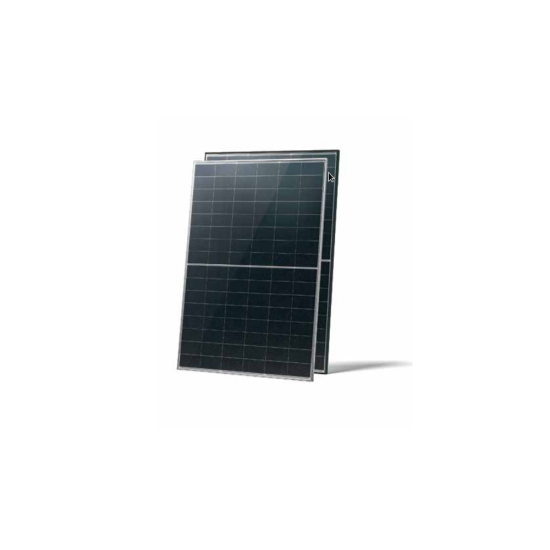
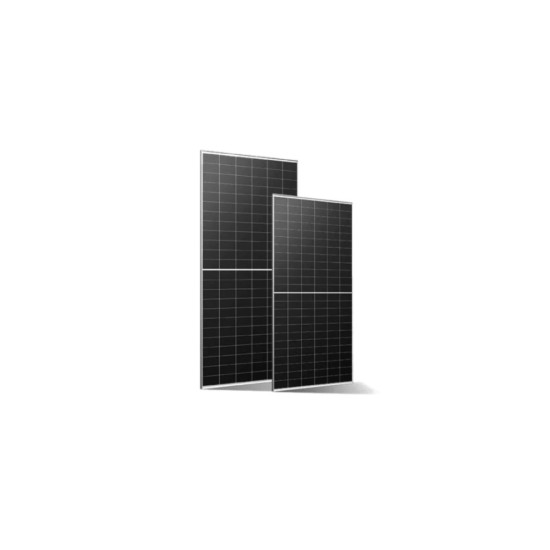
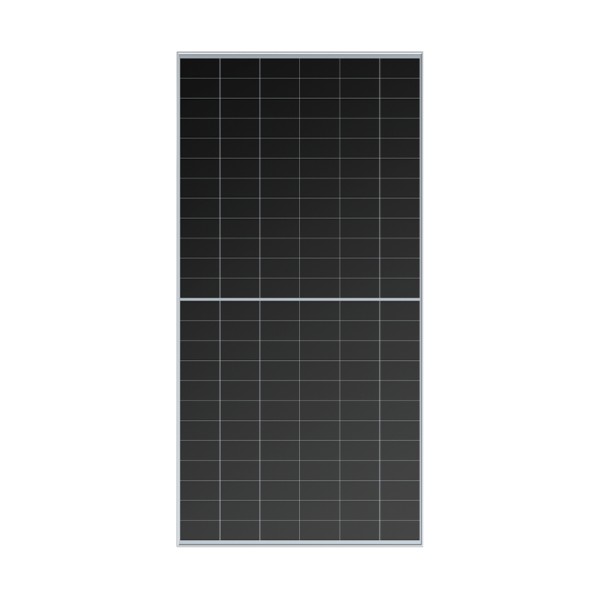
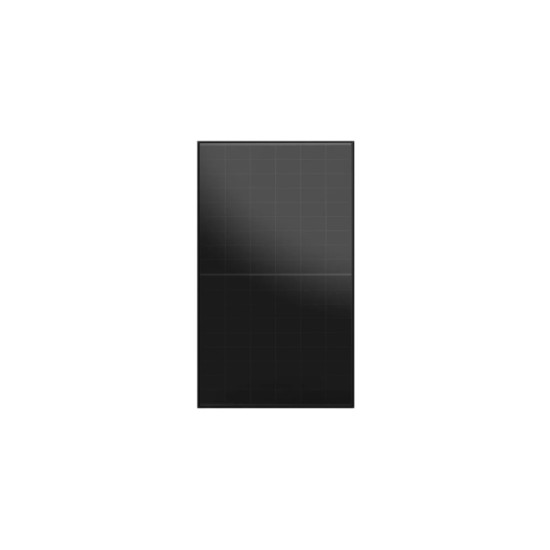
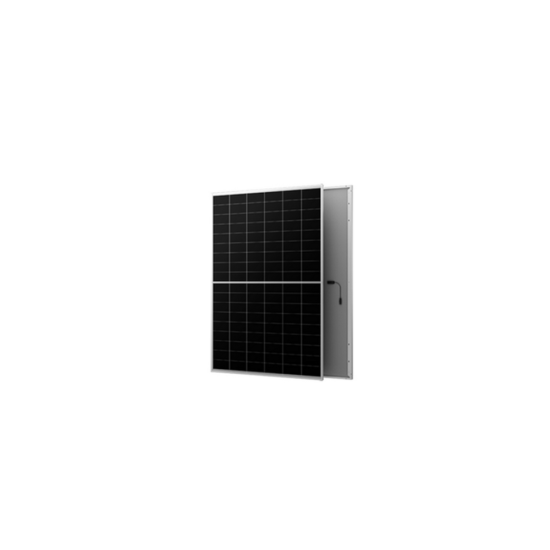
This is a photovoltaic panel for the home, built on a generation of cells called N-type, which also cope well with diffuse light - in the morning, in the evening or under clouds. Unlike classic panels, which have a plastic film on the back, this one has glass on both faces, a kind of thin double glazing that keeps the cells safe from hail, damp and aggressive air. The black aluminium frame gives it a discreet look on the roof.
At 1762 x 1134 mm the panel takes up about 2 sqm and weighs approximately 24 kg, so two people can carry it up and fix it without machinery. At 455 W apiece, roughly 11 panels make about 5 kWp on nearly 22 sqm, and 22 panels about 10 kWp on nearly 44 sqm (calculated from power and dimensions). It withstands 6000 Pa of pressure on the front, that is a thick layer of snow, and 4000 Pa on the back, that is wind suction - above what ordinary panels with a film offer. It connects to residential inverters of 3-10 kW (Deye, Huawei, Sungrow, Solis, Growatt), including hybrid versions with a battery, and maintenance amounts to occasional cleaning and a visual check of the fixings.
At STC: 455 W, Vmp 30.48 V, Imp 14.93 A, Voc 36.21 V, Isc 15.81 A, module efficiency 22.77%, 96 N-type TOPCon half-cells (HOT 3.0 technology, SMBB interconnection). The reduced Voc of 36.21 V allows longer strings at the same inverter voltage limit, which simplifies residential design. Pmax coefficient -0.29 %/°C, operating range -40...+85 °C, dual glass laminate with 2 mm front glass, 30 mm black anodised aluminium frame. Certified IEC 61215:2021 and IEC 61730:2023.
Who it suits
Suitable for a house with a 3-10 kW system, especially if the roof has a limited surface or is in an area with a lot of snow and strong wind.
Terms explained
- N-type: A type of solar cell that loses less of its power in the first years and works better in weak light than classic cells.
- String: A group of panels connected in series, like bulbs on a garland; their voltages add up, and the sum must fit within the inverter's limits.
- Hybrid inverter: The inverter that can also work with a battery, so that you use in the evening the energy produced at midday.
Technical specifications
| Rated power (STC) | 455 W |
|---|
| Module efficiency | 22,77% |
|---|
| Cell technology | N-type TOPCon (Tiger Neo, HOT 3.0), 96 semi-celule |
|---|
| Vmp / Imp | 30,48 V / 14,93 A |
|---|
| Voc / Isc | 36,21 V / 15,81 A |
|---|
| Dimensions | 1762 x 1134 x 30 mm |
|---|
| Weight | cca. 24 kg |
|---|
| Construction | Dual glass, sticla frontala 2 mm |
|---|
| Frame | Aluminiu anodizat negru |
|---|
| Pmax temperature coefficient | -0,29 %/grad C |
|---|
| Mechanical load | 6000 Pa fata / 4000 Pa spate |
|---|
| Operating temperature range | -40 ... +85 grad C |
|---|
| Certifications | IEC 61215:2021, IEC 61730:2023 |
|---|
Recommended applications
- Residential on-grid and hybrid systems of 3-10 kW
- Roofs with a limited surface, where the compact 1762 mm format helps with the layout
- Installations in areas with snow or strong wind, thanks to the 6000 Pa strength
- Agricultural and livestock applications, where dual glass resists ammonia better
Warranty
25-year product warranty / 30-year linear performance warranty
Technical details
Specifications confirmed from the manufacturer's datasheet
The JKM455N-48HL4M-DV is part of the JinkoSolar Tiger Neo range, built on N-type TOPCon cells with the proprietary HOT 3.0 technology and SMBB (multi-busbar) interconnection. The module has 96 half-cells (48 whole cells cut) in a dual glass laminate with 2 mm front glass, a 30 mm black anodised aluminium frame and an overall size of 1762 x 1134 mm.
At STC the module delivers 455 W, with Vmp 30.48 V, Imp 14.93 A, Voc 36.21 V and Isc 15.81 A, therefore a module efficiency of 22.77%. The relatively low open-circuit voltage (36.21 V) allows longer strings at the same inverter voltage limit, which simplifies the design of residential systems. The power temperature coefficient is -0.29 %/degree C. N-type cells have much lower LID/LeTID degradation than PERC and better behaviour in diffuse light, in the morning and in the evening.
The structure with glass on both faces offers high mechanical strength: 6000 Pa static load on the front and 4000 Pa on the back, above the level of classic modules with a backsheet - useful in areas with abundant snow or strong wind, as well as in environments with salt or ammonia (farms). The 1762 mm format and the weight of about 24 kg make it easy to handle by two people on the roof. The module suits residential inverters of 3-10 kW (Deye, Huawei, Sungrow, Solis, Growatt), including hybrid configurations with a battery. Certified IEC 61215:2021 and IEC 61730:2023.