Deye
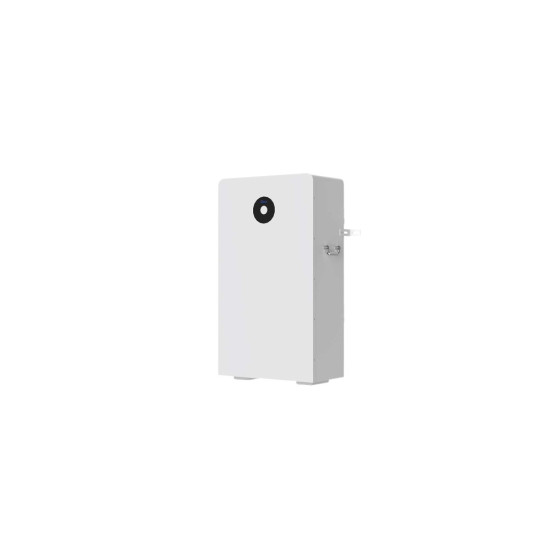
Deye RW-F16 battery, 16 kWh, LiFePo4
Autonomy for a whole evening: 16 kWh, of which 14.4 kWh usable, 160 A continuous and a 300 A peak for appliances that are hard to start.
LV
11.205,83 RON incl. VATexcl. VAT: 9.261,02 RON
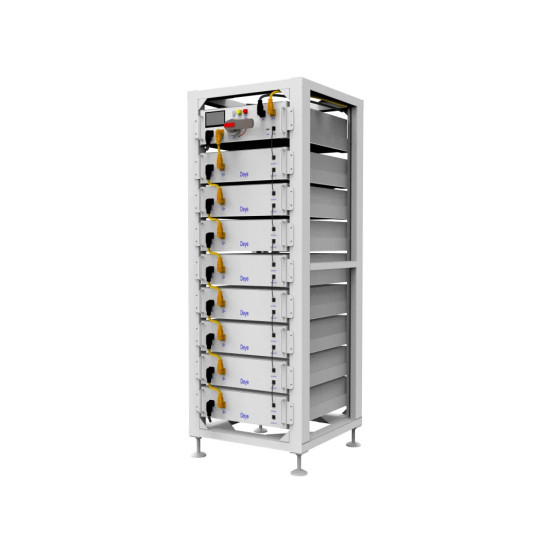
Energy storage for buildings with high consumption: 40,96 kWh from 8 modules of 5,12 kWh at 409,6 V, in a 19 inch rack, later expandable up to 61,44 kWh.
This is not a single battery, but a complete assembly: eight identical modules placed one on top of the other in a rack, connected in series, plus a control box that commands them all. The modules are the bricks that store the energy, and the control box is the brain that starts them, stops them, protects them and talks to the inverter. From the outside the assembly behaves like a single large, high voltage battery.
The 40,96 kWh are enough to carry a workshop, an office space or a building with high consumption through the night, or to shave the consumption peaks during the day. The system charges and discharges at 100 A nominal, with a peak of 120 A, so it moves energy at a good rate in both directions. It occupies a standard 19 inch rack, and the IP20 protection degree means indoor installation or in a dedicated cabinet, in a dry and clean space. A practical advantage: the series accepts between 3 and 12 modules, that is between 15,36 and 61,44 kWh, so you start from the present configuration and add modules later, if the activity grows, without changing the control box. The whole system status, the alarms and the main parameters are read on the integrated screen.
HV system of 40,96 kWh made of 8 BOS-G-Pack5.1 modules of 5,12 kWh connected in series, resulting nominal voltage 409,6 Vdc, within the 200-1000 Vdc range accepted by the control unit. Each module: LiFePO4 cells, 51,2 V nominal, 100 Ah, nominal charge/discharge current 100 A and peak 120 A, values also valid at system level, the modules being in series. BOS-G-PDU-2 concentrates the contactors, the protections and the master BMS, communicates through CAN and RS485 with the inverter and shows the status, the alarms and the parameters on the integrated display. 19 inch rack format, IP20, indoor installation or in a dedicated cabinet; the BOS-G series accepts 3-12 modules, that is 15,36-61,44 kWh. 10 year warranty.
Suitable for a workshop, an office space or a small commercial building, with a Deye high voltage hybrid inverter, that needs backup for the whole night and wants to be able to expand the capacity later.
| System energy | 40,96 kWh |
|---|---|
| Configuration | 8 module BOS-G-Pack5.1 x 5,12 kWh, in serie |
| Cell technology | LiFePO4 (LFP) |
| Nominal system voltage | 409,6 Vdc |
| Control box voltage range | 200 - 1000 Vdc |
| Nominal charge/discharge current | 100 A |
| Maximum current | 120 A |
| Control unit | BOS-G-PDU-2 (BMS master, protectii, display) |
| Communication | CAN, RS485 |
| Format | rack 19 inch |
| Protection degree | IP20 |
| BOS-G series expansion | 3 - 12 module (15,36 - 61,44 kWh) |
10 years
Series-level specifications — valid for the product family
The Deye BOS-G storage package of 40,96 kWh is a high voltage rack made of 8 BOS-G-Pack5.1 modules of 5,12 kWh each, connected in series, and of the BOS-G-PDU-2 control and management unit. The resulting nominal voltage is 409,6 V, within the 200 - 1000 Vdc working range accepted by the control box.
Each module has LiFePO4 cells, a nominal voltage of 51,2 V and a capacity of 100 Ah, with a nominal charge and discharge current of 100 A and a peak of 120 A. These values are also valid at system level, because the modules are connected in series.
BOS-G-PDU-2 concentrates the contactors, the protections and the master BMS, communicates through CAN and RS485 with the inverter and shows the system status, the alarms and the main parameters on the integrated display. The format of the whole assembly is a 19 inch rack, with protection degree IP20, so installation is done indoors or in a dedicated cabinet.
The 8 module configuration is an intermediate one in the BOS-G series, which accepts between 3 and 12 modules, that is between 15,36 and 61,44 kWh. The system can be expanded later by adding further modules up to the limit of the series.
Autonomy for a whole evening: 16 kWh, of which 14.4 kWh usable, 160 A continuous and a 300 A peak for appliances that are hard to start.
Keeps the energy produced during the day and uses it in the evening: 5.12 kWh, of which 4.6 kWh usable, 19 inch rack format and more than 6000 cycles.
Battery of 5,12 kWh for hybrid inverters on 48 V: over 6000 cycles, 100 A continuous discharge and the possibility of connecting up to 50 modules in parallel.
Modular high-capacity battery, from 9.9 up to 26.4 kWh, designed to cover the evening and the night. 30 A continuous, efficiency above 96%, over 6,000 cycles, IP65.